ISBN: 0679734996
Publisher: Vintage
Year: 1991
Format: 249 Pages
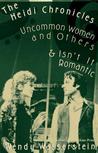
The Heidi Chronicles: Uncommon Women and Others & Isn't It Romantic
Synopsis & Analytical Review Framework
Reader Critical Response Manifest
Love me some plays by Wasserstein. She's very funny in that wry way women have, the one that says you have to laugh at this crap or you will be out on the streets killing catcallers. Or is that just me? Library copy
plays
I recently re-read these plays, and although they're clearly set in a certain time period, they still ring very true.
When I requested this from the library I thought I was getting the play "The Heidi Chronicles" and I was, but I was also getting "Uncommon Women and Others" and "Isn't It Romantic." What a delightful combination! The first is a play from 1977 that I knew well then; I did Holly's monologue in college. "Isn't It Romantic" I knew only from Wasserstein's biography. "The Heidi Chronicles" I'd heard of - I don't quite live under a rock-- it won the Pulitzer Prize and Tony, but I haven't seen a production of it. "Uncommon Women" is dated, but it's also still a wonderful piece of writing and I'd love to see it staged again. "Isn't it Romantic" is from 1983 and it's about Janie and Harriet who have moved back to New York City after going to college, their parents and their lovers and their careers. "The Heidi Chronicles" came to Broadway in 1989 and takes place in roughly chronological scenes from 1965 to 1989 and is about these years in the lives of Heidi Holland and Susan Johnston, their boyfriends, careers and families. It's a great play with dialogue that jumps off the page. As one of the characters might say: "A+!"
I felt a lot of the emotions that Heidi did as I was reading this play. But the final image made it worth it.
I had only been exposed to one of Wasserstein's plays, when I played the role of douche bag Paul Stuart in 'Isn't It Romantic' while still in high school. The subject matter was over our heads then and the play- even with having two very strong female leads- wasn't what it could have been. Still, it provided for an introduction to her work. Now, approaching 30, I picked up her plays, which include the aforementioned, and I most definitely understand the themes and complex, nuance struggles of the characters. I also understand Wasserstein's awards, accolades and fan base. She really was hitting the nail on the head with the prevailing gender role issues that were a part of the past three generations of American life. Her sincerity, keen observations, sarcasm and general optimism permeates what could be a very dark group of plays. Beautiful work. Very happy to reread 'Isn't It Romantic' especially.
I picked this up for my Modern Drama class in college. I had to choose a playwright we were not studying in class to read and write a paper about. My dad suggested Wendy Wasserstein for he thought she was up my alley. Oh, how I loved this play. I read all of her plays in print for my assignment, but the Heidi Chronicles is so true, so heartbreaking, and touched me in a way few authors are able. It stands the test of time and does not date itself. I have given this to many friends during some tough times in their lives.
This book of three short plays from the 1970s and 1980s is a delightful flashback for me. I will go to my 50th high school class reunion this year. It will be interesting to see how many of us managed to have it all. A random speech from the first play, Uncommon Women and Others: HOLLY: What kind of pleasure? There's someone on top of you sweating and pushing and you're lying there pretending this is wonderful. That's not wonderful. That's masochistic. Well, this is a feminist play from the 70s! What did you expect? Here is the description of Holly at the front of the play: HOLLY KAPLAN: hair disheveled, yet well cut. She wears expensive clothes that don't quite match, not because she doesn't know what matches, but because she doesn't want to try too hard. That would be too embarrassing. A relier for many years on the adage "If she lost twenty pounds, she's be a very pretty girl, and if she worked, she'd do very well," Holly has devised a strong moral code of warmth for those you love and wit for those you're scared of. Holly saw the Radio City Easter Show in second grade and planned to convert. Andre Bishop writes in the Foreward: Reading the plays of Wendy Wasserstein is quite different from seeing the plays of Wendy Wasserstein. In the theatre, they are consistently funny; the comedy sparkles. Yet when one sits down to read these three plays, one is surprised, almost overwhelmed, by their seriousness. It seems to me that Wendy's plays are ideas that happen to be written as comedies. The three heroines, though vastly different, share an essential sadness, but it is a sadness deflected by humor, because these are witty women and they use their wit to devastating effect. The thing is: I think maybe I just should have been born Jewish. That way I could have a heritage without having to be religious. I just love these Jewish characters and I loved the Jewish women in the Grace Paley short stories I just read. I must have lived in NYC in a past life. Or maybe I will in a future life! A random speech from the second play, Isn't It Romantic: HARRIET: Mother, do you think it's possible to be married or live with a man, have a good relationship and children that you share equal responsibility for, build a career, and still read novels, play the piano, have women friends, and swim twice a week? In the third play, The Heidi Chronicles, Heidi gives a talk to an alumnae group in 1986: Well, you might be thinking, this is a woman's meeting, so let's give her the benefit of the doubt. After teaching at Columbia yesterday, Miss Holland probably attended a low-impact aerobics class with weights, picked up her children from school, took the older one to drawing-with-computers at the Metropolitan, and the younger one to swimming-with-gifted-children. On returning home, she immediately prepared grilled mesquite free-range chicken with balsamic vinegar and sun-dried tomatoes, advised her investment-banker, well-rounded husband on future finances for the City Ballet, put the children to bed, recited the favorite Greek myths and sex-education legends, dashed into the library to call the twenty-two-year-old squash player who is passionately in love with her to say they can only be friends, finished writing ten pages of a new book, took the remains of the mesquite free-range dinner to a church that feeds the homeless, massaged her husband's feet, and relieved any fears that he "might" be getting old by "doing it" in the kitchen, read forty pages of the Inferno in Italian, took a deep breath, and put out the light. So after all this, we forgive Miss Holland for not preparing a speech today. She's exemplary and exhausted. If you are a baby-boomer or a feminist or an over-achiever or simply know someone who is, you might enjoy this quick-read that will give you something to relate to, to remember and to think about for a while. Those were the days. Five stars. One extra for the nostalgia. Winner: 1989 Pulitzer Prize for Drama.
The book has witty conversation but that was really all i liked about it. I liked the main character but the ending didn't quite agree with me. It felt unfinished :/
Thoughts to come on my blog (if I can articulate them...)
Search External PDF Documents
Search for public PDF files, digital document editions, and research papers for The Heidi Chronicles: Uncommon Women and Others & Isn't It Romantic on major search engines:
Related Search Topics & Keywords
Correlated Literary Frameworks

Harry Potter and the Half-Blood Prince (Harry Potter, #6)

Harry Potter and the Order of the Phoenix (Harry Potter, #5)

Harry Potter and the Sorcerer's Stone (Harry Potter, #1)

Harry Potter and the Chamber of Secrets (Harry Potter, #2)
